Myrtle Keeton's doll
Needful ThingsMyrtle Keeton’s doll is a beautiful object glimpsed in the window of Needful Things and acquired by a woman whose marriage has left her frightened and isolated. It matters not simply as a collectible: Myrtle has long used dolls as companions when her husband’s anger drives her into tears, and this new purchase arrives at the same time as a startling change in their relationship. The doll’s promise of comfort is therefore entangled with the shop’s wider power to make private longing feel like a need that can be bought and possessed.
Appearance and Acquisition
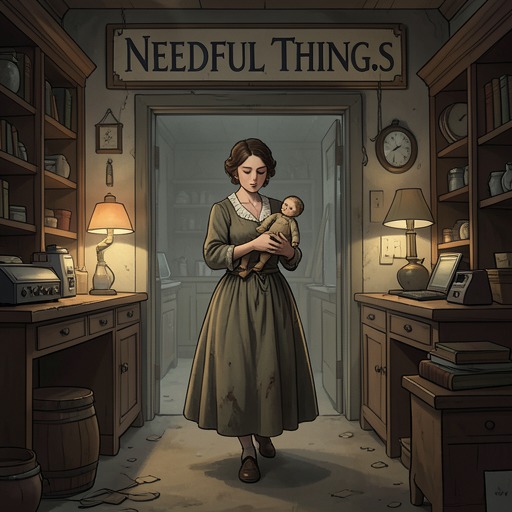
Myrtle sees the doll while driving back from The Country Oven, where she has bought honey-glazed doughnuts for herself and chocolate-coconut ones for Danforth. A glance at the Needful Things window makes her brake so abruptly that a following car might have struck hers. The doll is displayed in the window, and the shade has been raised again; the sign on the window once more reads OPEN. The scene marks a sharp turn in Myrtle’s attention: she had been thinking of bringing home a small treat to cheer her husband, but the doll immediately eclipses that errand.
The glimpse is especially powerful because Myrtle is already a collector. She began collecting dolls in the first years of her marriage and kept them boxed in the attic. In the previous year, she brought them down to the sewing room, where she sometimes went after crying and played with them. The doll in the new shop becomes, in her own estimation, the most wonderful of the collection. Needful Things offers no ordinary price tags, and its transactions operate through the wants of individual customers; the doll’s appeal is consequently presented less as a matter of practical use than as an object charged with Myrtle’s particular longing.
Myrtle’s Private Refuge
The dolls provide Myrtle with a form of companionship that her marriage denies her. When Danforth grows angry, his rages overwhelm her; she has given up answering in anger and instead smiles helplessly, promises to do better, and retreats to their room to weep. In the sewing room she turns to the dolls. They do not shout at her, ignore her, or belittle her. That contrast gives the collection a concrete emotional function: it is a private space in which Myrtle can approach objects without being judged or intimidated.
The new doll intensifies that refuge. Myrtle finds it at Needful Things, and by the following morning she feels that everything has changed. The narration does not claim that the doll itself causes Danforth’s altered behavior; it places the purchase beside the change without explaining its mechanism. Myrtle, for her part, is afraid to ask what has happened and chooses to enjoy the improvement rather than interrogate it. This uncertainty keeps the doll’s role poised between material possession and emotional sign: it offers Myrtle a cherished object at the very moment her ordinary domestic world seems, briefly, to have become kinder.
A Sudden Change at Maurice
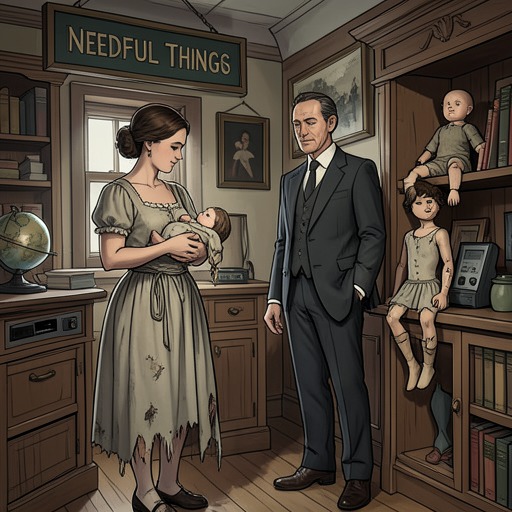
The morning after Danforth’s night at Lewiston Raceway, Myrtle expects to find him absent from their bed or asleep in his study chair, as had often happened before. Instead, he is beside her in the striped red pajamas she gave him for Christmas the previous year, worn for the first time as far as she knows. He faces her with a smile so unfamiliar that it initially frightens her; she thinks it might mean he is preparing to kill her. He then touches her breast and asks whether she wants to make love, and they do so for the first time in more than five months.
The reversal continues at lunch in Maurice. Danforth eats heartily and smiles, while Myrtle pinches herself under the table to make sure she is awake. She reaches across the table to touch his hand, wanting to trust the reprieve but not knowing what brought it about. The doll is not identified as the cause of this change, and the account preserves that gap rather than resolving it. Its narrative significance lies in the timing: Myrtle’s discovery of the most wonderful doll she has ever seen is immediately followed by a morning in which the husband she has feared seems transformed.
Possession and the Novel’s Bargain Economy
The doll belongs to a larger pattern in Needful Things, where objects become compelling through claims of rarity, provenance, or personal meaning. Brian Rusk, for example, is drawn to a piece of wood presented as a possible fragment of Noah’s Ark and to the exceptional value of a well-preserved Sandy Koufax card. The shop’s display has no price tags, and a sign announces that it gives no refunds or exchanges, invoking caveat emptor. These details make acquisition feel less like a transparent exchange than a bargain whose terms are shaped by the customer’s desire.
For Myrtle, however, the doll’s force is inseparable from the history she brings to it. Her existing dolls are not merely decorative possessions: she has moved them into the sewing room and turned to them after being hurt by Danforth’s words. The new doll extends that established comfort, while the sudden marital reprieve makes the purchase seem momentarily aligned with a happier life. The distinction between what the object can provide and what Myrtle hopes it will mean remains unresolved. In that tension, the doll becomes a small, intimate instance of the shop’s larger design: a thing can feel indispensable when it answers a loneliness, even though possession cannot by itself explain or secure the change a person longs for.